I was recently asked in an interview for Canon, am I first and foremost a photographer? Or wildlife lover?
My answer was, I started out being and am still a devoted naturalist!
Photography has thus been my medium of creative expression to showcase my passion for the natural world, and hopefully in some way, do justice in an artistic way to the incredible icons that cross my lens.
As such, from time to time I thought rather than simply posting my best fine art photographs, I would like to take you back to my roots as a naturalist by showcasing the amazing behaviors we witness in the field en route to creating my fine art photographs.
I thought I would kick off with a story about a small creature. It is a story about a frog with a big attitude and an even bigger appetite!
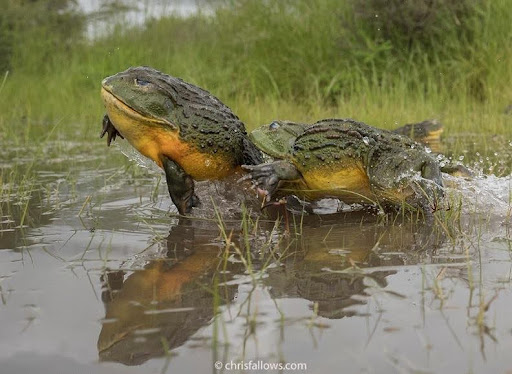
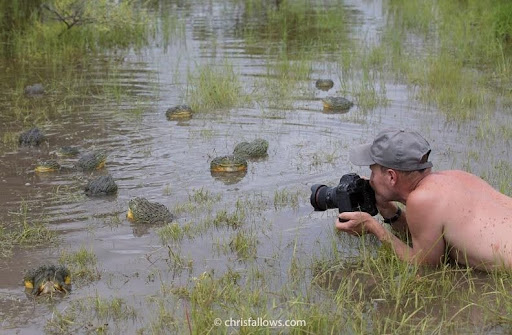
Several years ago, in one of the rare big rainfall years in Botswana’s huge wilderness known as the Central Kalahari Game Reserve, Monique and I were held spellbound as the heavy rains triggered the emergence of ‘Frogzilla’ from their aestivation and slumber underground.
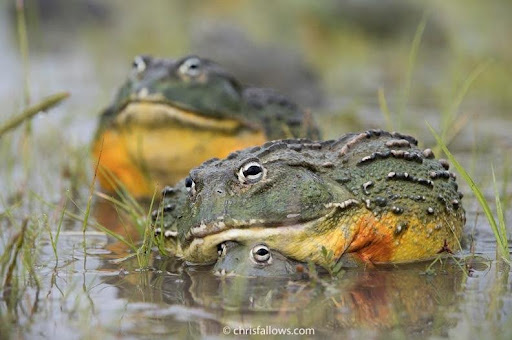
All around us, huge 1,5kg fanged Jabba-the-Hutts engaged in warfare in their quest to procreate.
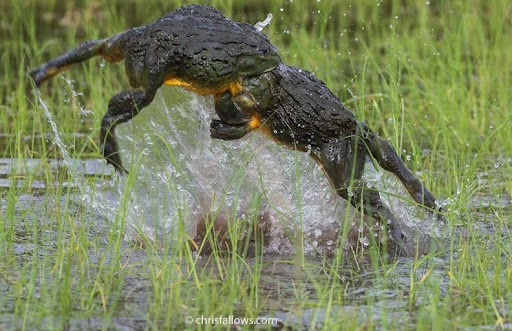
Airborne engagements of ‘frog trying to swallow like-sized frog’ played out a few inches from my lens as I lay unmoving in pools of rainwater that these frogs used as their colosseums for their froggy fornication.
It was incredible to witness.
Massive males would fight for the right to have their foot or so of space from which they would vocally extoll their virtues to any female who would listen.
She would then enter the fray by surreptitiously swimming underwater from the outside of the cauldron of testosterone-city, to its centre. The dominant male, who had fought off all comers, would then have the right to mate.
I literally spent hours lying in the water with the frogs to gain their trust. Eventually, and rather unflatteringly I think, they thought I was one of them as a series of attacks on my camera made me realise they thought I was competition.
This resulted in a rather humorous evacuation of their pond as the crunch of their teeth across my lens led to an extollation of profanity on my part.
It was thus with great excitement when we revisited the CKGR this year that Monique and I, along with our good friend Jens Cullman, stumbled across a small pond where young bullfrogs were now engaged in their quest to survive.
Whilst we were in the CKGR looking to find rare, black-manned lions with which to create fine art photographs, it was the bullfrogs that stole the show.
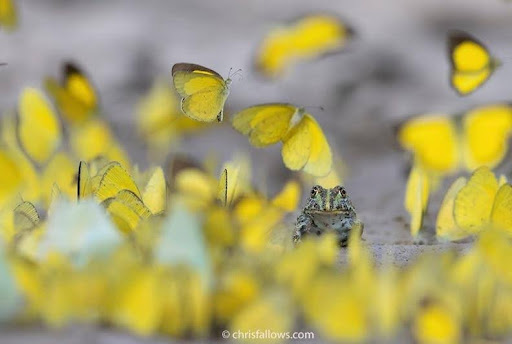
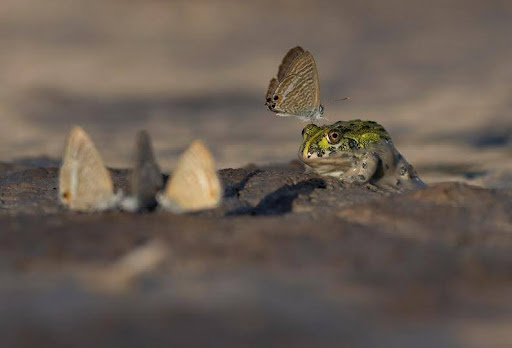
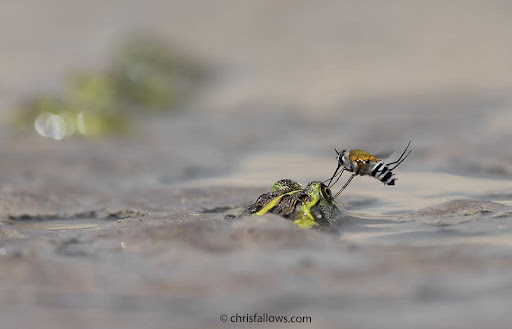
We positioned ourselves next to the pond and slipped under our vehicle where we spent upwards of 4-6 hours per day flexing our necks and back, craned in all sorts of uncomfortable positions trying to photograph the frogs hunting some of the many thousands of beautiful butterflies that were attracted to the mineral and salt rich edges of the mud.
The 5cm-7cm young bull frogs were absolutely mesmerizing to watch. Firstly, they specifically targeted the small Lycaenid butterflies, a family of butterflies commonly known as blues or coppers, over the slightly larger broad bordered grass yellows, of which there were tens of thousands.
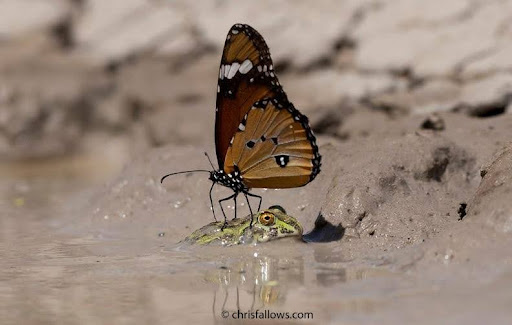
Only occasionally would they go after the even bigger African Vagrants, or African Monarchs which are poisonous, storing toxins inside them from the milkweed that they feed on.
To keep things interesting the Lycaenids were lightning quick which made needing to use guile and stealth all the more important on the frog’s part.
It was just like watching lions stalking a zebra or antelope.
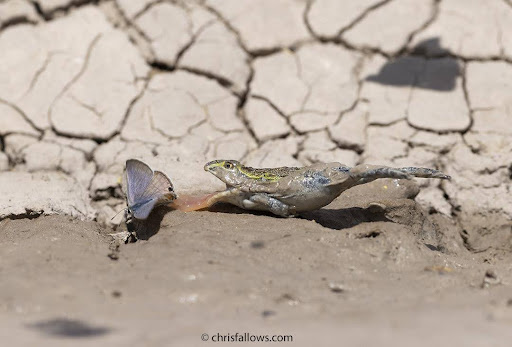
Inch by inch the frogs would crawl forward whilst at the same time flattening their profile. When they thought they were within striking range, they would stop and then wait for anything from a few seconds to over a minute before launching a super-fast leap at their prey with their incredibly long and sticky tongues protruding ahead of them like some alien creature’s probe.
Some frogs were clearly far better hunters than others with bulging bellies attesting to their success.
Others were downright comedic in their efforts with some cartwheeling. Others would land short of their prey, and others whose long sticky tongues got stuck to the ground where the butterfly had been, causing the frog to go somersaulting as their tongues refused to let go of the ground, akin to an anchor gaining solid purchase when thrown out of a car going at high speed.
There were so many amazing moments, like watching dozens of butterflies landing on the frogs’ heads, and seeing the frogs thinking ‘what the hell do I do now, how do I catch this thing that’s landed on me?’
Others grabbed wasps that stung them, and a few took on the poisonous monarch butterflies. This was a fascinating side show as they fairly easily caught the butterflies, mostly by the wings, but when they bit into the butterfly’s abdomen, they quickly let them go. About half the time the butterfly flew away as if nothing had happened.
On a few rare occasions we saw a frog completely consume the monarchs leaving us wondering how the frog managed to handle its poisonous meal.
Photographically it certainly wasn’t fine art, but hell was it fun and took me back to my days of shooting action photography with the great white shark hunting seals with lightning-fast reflexes needed.
Sadly, these reflexes have slowed over the years. So much so that I found myself getting seriously annoyed as time after time I wouldn’t be quick enough for the split-second strike, and so I resorted to a different strategy of holding the trigger down, hoping the frog would jump.
Occasionally this paid off, but there were many times where I was blazing at 20 frames a second where the frog just sat there motionless! I would burn through my buffer only for the frog to then leap spectacularly through the air.
All in all, it was an amazing three days spent cramped under Jens’s car with stiff neck and aching back being painful momentos of a time in the company of a lesser known, but very formidable little hunter of the African landscape.