
Final editions, world records, and a season of unrepeatable moments
While I’ve spent over 25 years building a portfolio of wildlife fine art, it was only in 2021 that I felt the work had matured into an investment-grade collection.
This collection brings together a select group of pieces defined by strong artistry and a commitment to portraying our planet’s most iconic animals with the respect they deserve.
Equally important, however, is the collector. It is a true honour when someone connects with my work, whether emotionally or as an investment. With so many choices available from the likes of great photographers like Yarrow, Brandt or Nicklen, I remain deeply grateful for that support.
Selling art is very different from creating it. Monique and I are not business or marketing specialists, rather we are naturalists and storytellers, dedicated to in my case to artistically photographing iconic wildlife, and elucidating on those experiences, from some of the wildest places on earth, and this is where we are most authentic.
As the Chris Fallows brand continues to grow, we therefore are delighted to welcome North America-based art consultant, Amy Wilkins, to our team.
With Amy’s guidance, we’ve seen strong sales at the start of the year. Thank you to all who have supported us. Record prices are being achieved—Air Jaws, The Pearl, and The Fig and Elephant now approach or exceed USD $25,000 per print as demand continues to grow and their respective editions near their end.!
This validation is both humbling and inspiring as it affirms that the art within nature resonates deeply.
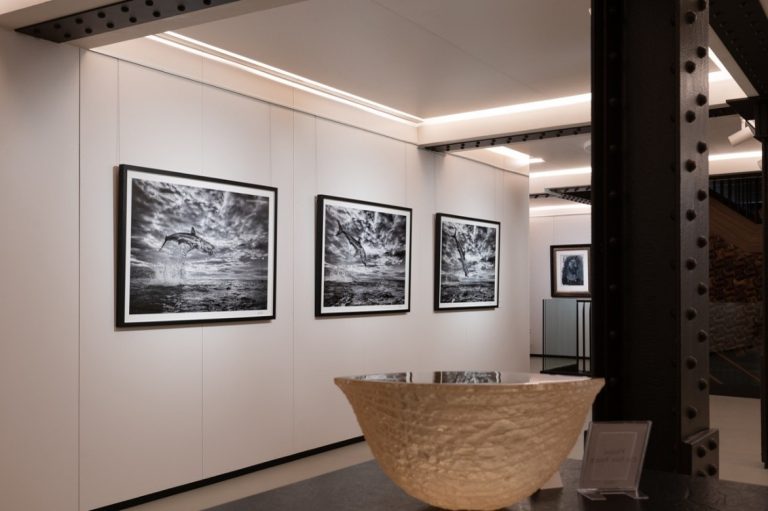
As editions approach the final available numbers, in the case of the iconic breaching great white shark works, we believe final prints have the potential to reach six-figure values.
That said, this milestone comes with mixed emotions. The Great white shark works represent the very core of my portfolio, capturing moments that are now no longer possible to document. Because of this, they are not only visually iconic, but fundamentally unrepeatable.
In this conundrum lies the motivation behind much of the narrative that defines my work – Our natural works is fragile, and even the greatest are easily felled.
In this regard, and wearing my conservation hat, I recently spoke with Anderson Cooper on CBS 60 Minutes about the disappearance of great white sharks at Seal Island, South Africa, and I was honored to have my photographic work chosen as the 60 Minutes Overtime piece.
I managed to find a gap in a fairly crowded news week, so not sure where that places me in the grand scheme of things

Whale World Record!
On another light note, December 2025 ended with Monique and I quietly breaking a “whale world record.”

As an artist, each day in the field begins with a clear image in my mind – the next fine art photograph I hope to create. But beyond the art, there is also the naturalist in me, driven to contribute towards increasing the understanding we have with our subjects. Of course, this increased knowledge also has its benefits for my photography, as knowing where and when to best position oneself for any likely behavioral outcome puts you at a distinct advantage.
So, when the light, conditions or backgrounds aren’t right for artistic work, it’s an opportunity to turn to contributing images for science.
On the 29th and 30th of December 2025 we broke the world record on consecutive days, with 208 and 300 different individual humpback whales photographed in a single day. The images was submitted to Happywhale where the identifications were catalogued, and the final count of individual whales were made.
It is an incredible number, not only for the sheer density of whales in one area, but for what it represents. This may be the largest gathering of humpbacks recorded by human observers in the modern era, certainly since the end of industrial whaling. More importantly, it reflects the recovery of an iconic species, offering hope for what is possible with enlightened governance and policies.
For World Earth Day on April 22nd The BBC as their feature showcased this story on their platform.

With over 300 whales around us, inspiration was never in short supply to create beautiful art works celebrating what many consider the symbol of the sea. With incredible lofted flukes, ghost-like exhalations of breath, and at times magical light, there was plenty to point a lens at.
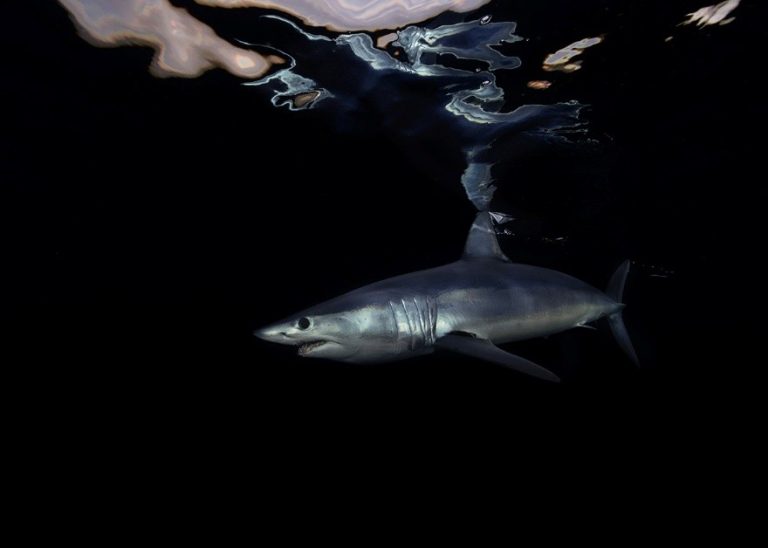
The unusually settled weather in March and April saw Monique and I return to our roots, heading far offshore from the south-western tip of Africa in search of what I consider to be the most beautiful shark in the sea, the jet-fighter-like mako.
Over the decades, I’ve been fortunate to encounter hundreds of makos of all sizes, from football-sized dynamos to 12-foot imposing giants. Time and experience have allowed me to somewhat read and anticipate their behavior, and this helps me to create the strongest photographic opportunities.
As with any subject of great beauty, light is everything. With mako sharks, this requires me to free dive and photograph them into the night. These specific black water conditions create the perfect backdrop to reveal their spectacular form and colour.
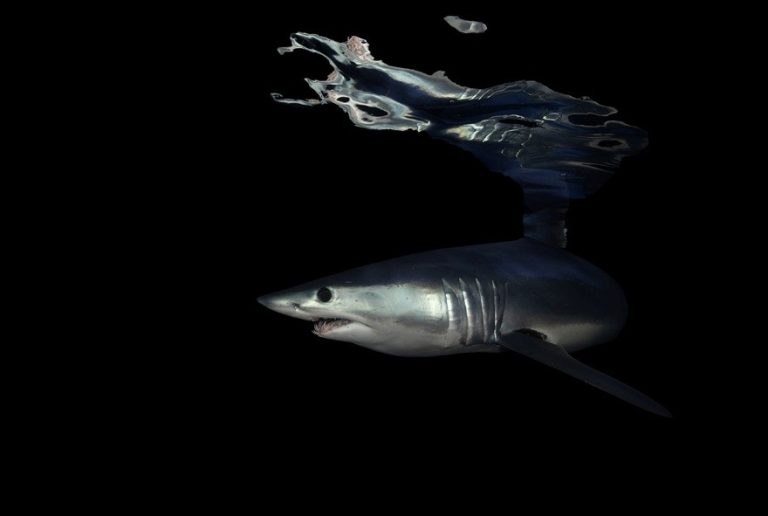
I usually work alone on these shoots which allows me complete focus on my subject. In these highly charged moments often quick decisions are required to interact with these super predators safely. It is high-adrenaline work, where experience and instinct are crucial. I like to hope the results do justice to a predator whose shape, form and livery are simply magnificent.
April again saw the spectacular arrival of super pods of common dolphins, feasting en masse on huge shoals of seasonal baitfish.
A super pod typically consists of over a thousand individuals. I am often asked how we know there were a thousand dolphins. The truth is, we don’t, but having spent significant time observing vast concentrations of animals, it is our best estimate.

Irrespective, whether we are a few fins above or below on our count, the sight of an immense body of dolphins moving at speed through the water is extraordinary to behold.
Ironically, it is also something I have artistically struggled with over the years, as perhaps too much choice can lead to a lack of clarity.
A concept I have in mind relies on a glassy calm sea, large rolling swell, and a school of dolphins moving synchronously across this canvas into the negative space ahead. It sounds simple, but capturing dozens or more dolphins, all travelling in the same direction across a tiered marine landscape, without distracting the eye, is incredibly difficult.
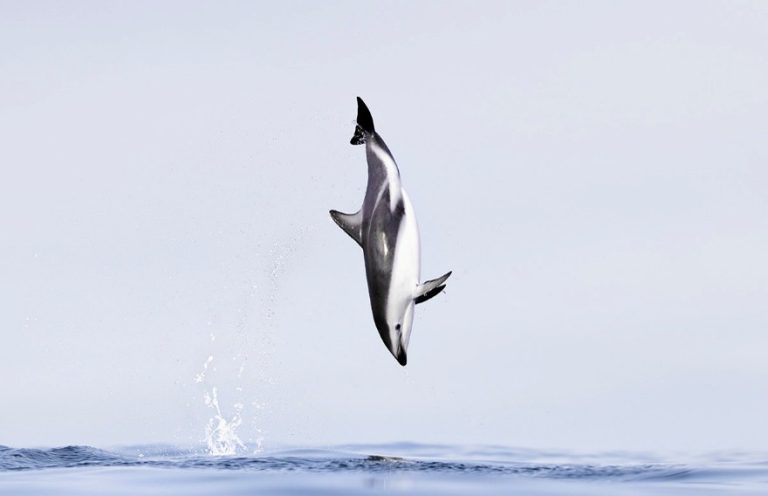
Another expression I have been working towards is a single dolphin leaping from the water, captured from a very low angle on a glass-calm surface, reflecting both athleticism and art.
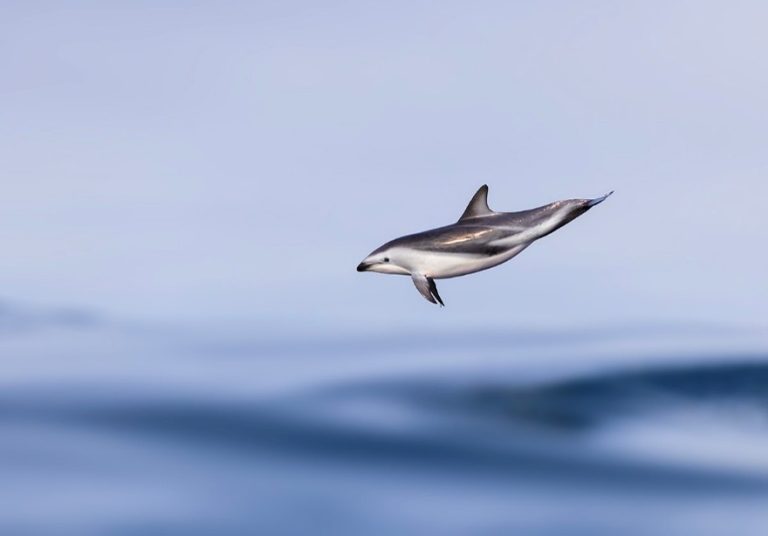
Recently, I have had a few magical moments pursuing this vision, although not with Common Dolphins, but rather with super pods of unbelievably athletic Dusky Dolphins.
This beautiful species, smaller than the Common Dolphin, is renowned for its exuberant displays of aerial gymnastics.
Can I improve on what I have achieved? Who knows. But for now, I believe I have a solid peg in the sand.
I’m thrilled to be exhibiting my work for the first time in New York with Montague Contemporary.
The exhibition, titled Two Tides, will include some irreplaceable Limited Edition photographic works of the famous flying Great White Sharks of Air Jaws fame. Also included are some of my premium whale, lion and elephants works created over the past 3 decades.
Opening night – 19 June.
Exhibition extends to August 1.
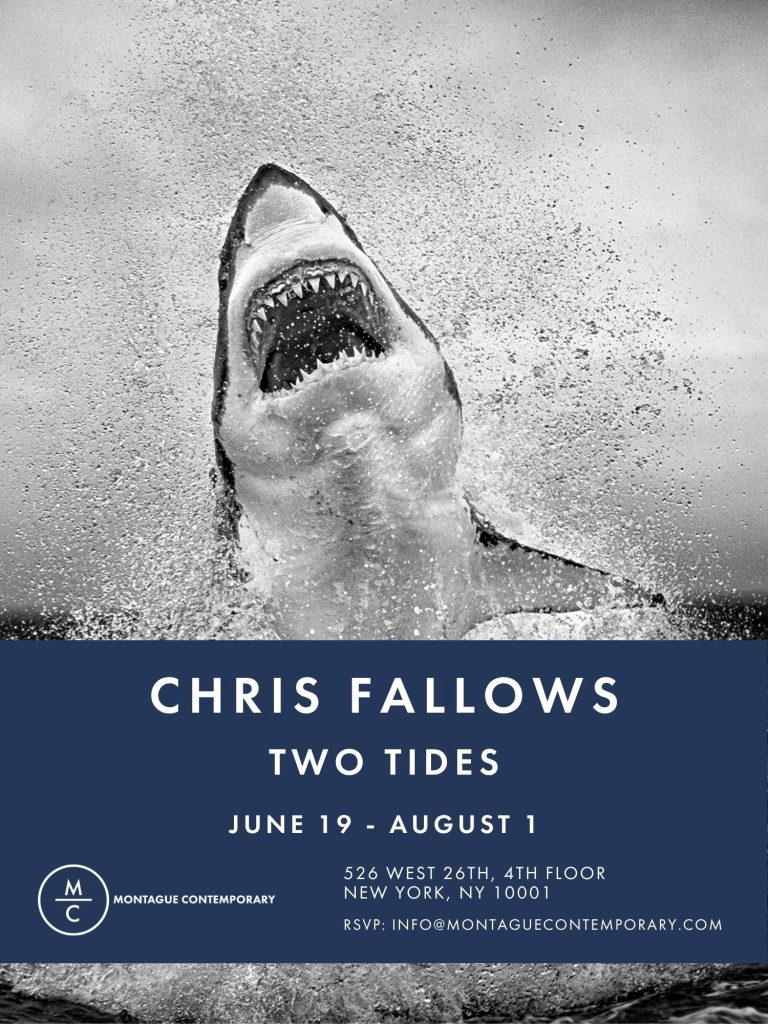
We hope that many of you will be able to view the exhibition in NYC, and to those of you who have supported our work, we are deeply appreciative.
Best wishes
Chris & Monique
