Whilst my artistic genre is fine art photography, first and foremost I am a naturalist with a very deep connection to my subjects and their behavior, which then shapes how I creatively portray them.
As a naturalist the field is your office and be it the ocean or earth, you crave being in the wild. The longer you spend out there, the more exciting things become as you understand it so much better.
Animals are no longer just compartmentalized into species level, but rather you begin to know animals as individuals. In essence you get to know their personalities, strengths, weaknesses and what makes each unique.
Our thirty years spent with the great white sharks ingrained this in us, and with this enlightenment, we got to know many other species on an individual level within the great white shark ecosystem.
One of these creatures were the magnificent and formidable orcas that we came to know along the South African coastline.
As our expeditions and photographic work didn’t limit us to one location, we spent considerable amounts of time over a vast stretch of coastline and encountered orcas in East London, Mossel Bay, Gansbaai, False Bay, far off Cape Point, Hout Bay and up the west coast as far as the Langebaan area.
This is a stretch of well over 1000km.
In addition to this, we saw orcas in Canada, USA, Argentina, Antarctica and Norway, and we also had some of the world’s leading orca experts teach us about these amazing predators.
What we saw pretty much wherever we travelled was an animal that was a specialist, in each location they performed behavior specific to their area.
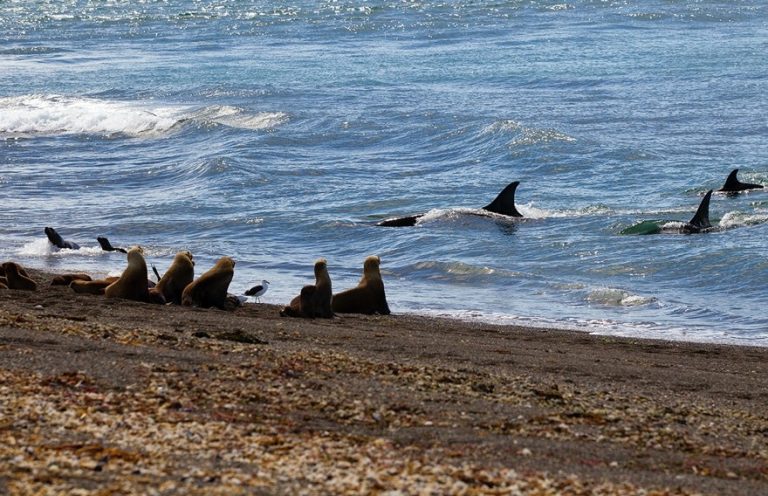
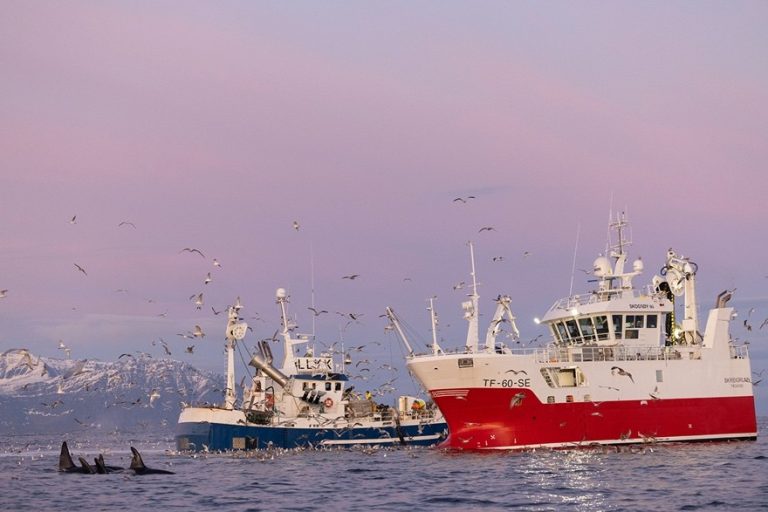
For example, in Argentina at Punta Norte on our friend Juan Copello’s estancia, we saw a family of orcas who beach themselves to catch seals. Whilst in Norway with our biologist friend Eirik, we observed how they corralled herring, and in Antarctica we learnt how they cooperatively wave-wash seals off small ice chunks.
In South Africa we saw three different types of specialists:
The mammal hunters which we first saw in 2009 and more than 30 times since; the notorious shark hunters whom we first observed in 2016 and various times since then; and then the fish hunters whom we have only seen once offshore, but they could also be part of the shark hunting group.
What we noticed, as we record all data, is that the mammal hunters socially behave very differently to the shark and fish hunters when it comes to interacting with us.
Perhaps this is due to run-in’s with fisheries. These fish-eating orcas frequently come into contact with fishing vessels and are often shot at as they scavenge the fishing lines. This could be one of the reasons the ‘shark-hunters’ are generally very shy and aloof.
So much so that one family of 7 or 8 orca that we spent 7 hours with off Cape Infanta after observing them catch and kill a common thresher shark in May 2022, and again with whom we spent for 9 hrs with between Dassen Island and Hout Bay in Feb 2024, showed very little interest in us. As such we kept a respectable distance from them, which was actually at the distance that they defined.
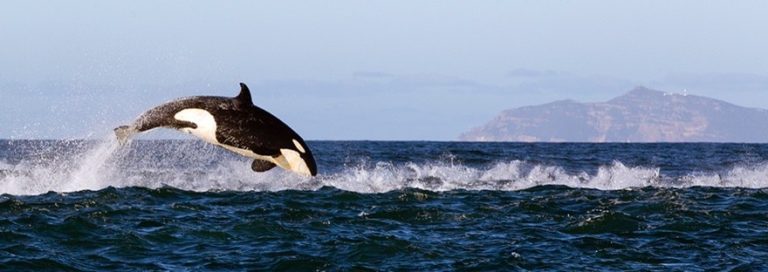
The mammal hunters, however, are completely different, often choosing to come to our boat and bow-ride. In the case of one remarkable female, who has a notable deformity, and whom we have called “Mannemerak,” she often chose to come straight to our vessel and ride right alongside it, not more than 2-3m away. Sometimes she would swim like this with us for more than half an hour at a time.
On various occasions around the world we have witnessed the adults teaching their young to hunt, and with the mammal hunters, it is a fascinating, albeit often tough spectacle to observe.
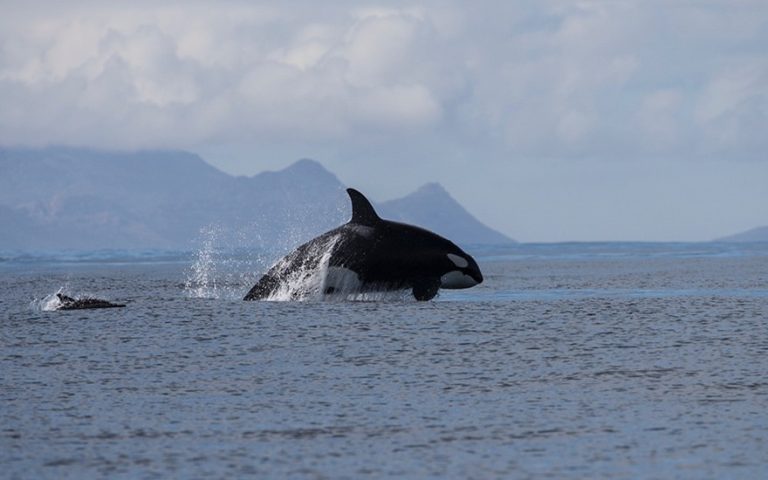
On one occasion, on the 21st May 2013, we were with a family of 10 orcas who had successfully separated an adult common dolphin from its huge school. This dolphin was incapacitated to the point where it could still swim well, but not to the point where it could easily escape.
At this point, a huge male orca and another full-grown female allowed a youngish calf to swim with them as they shadowed the dolphin. This went on for at least ten minutes with the deadly triumvirate following the dolphin at about 50 to 100m, neither gaining nor falling behind the hapless dolphin.
We positioned ourselves about 30m to the side of the dolphin, maintaining an equal speed and parallel course. Suddenly, on what must have been a clear cue from one or maybe both adult orcs, the young orca broke rank and quickly covered the distance to the dolphin, ramming it mid ships which stopped the dolphin dead in its tracks.
The young orca grabbed it and swam it directly towards where our stationary boat was now drifting, passing right next to us as if to show us its prize. The other orcas then caught up and all dived down together to food-share below.
It was an incredible experience to have witnessed completely alone with this family of orcas that were so comfortable with us joining the hunt.
We saw so many other amazing hunts where various techniques were used. Unlike the great whites ,that were instinctual hunters, the orcas were thinkers constantly adapting to the situation in front of them.
We saw how one orca would race ahead of fleeing dolphins, cutting them off, and then chase them towards where another was waiting to ambush it.
We saw them drive dolphins towards the shoreline where they would give the dolphins no escape.
Incredibly, we also saw how the orcas would kill one dolphin, feed on it, and then half an hour after the dolphin school had fled at high speed, the orcas would know exactly where to find them again in a huge bay of over 1000km2. The orcas would head with perfect precision the often 40km or more to where the dolphin school thought itself to be safe.
Quite frankly, whilst most things in nature are perfectly balanced, orcas seem to have an upper hand when it comes to intelligence, strategy and teamwork.
And so, it is another amazing event including Mannemerak and her family that I would like to share that occurred just a few days ago that not only showcased their extraordinary hunting prowess, but also strong personalities, teamwork, and the schooling of a youngster to become part of the rank of the oceans’ elite hunting machine.
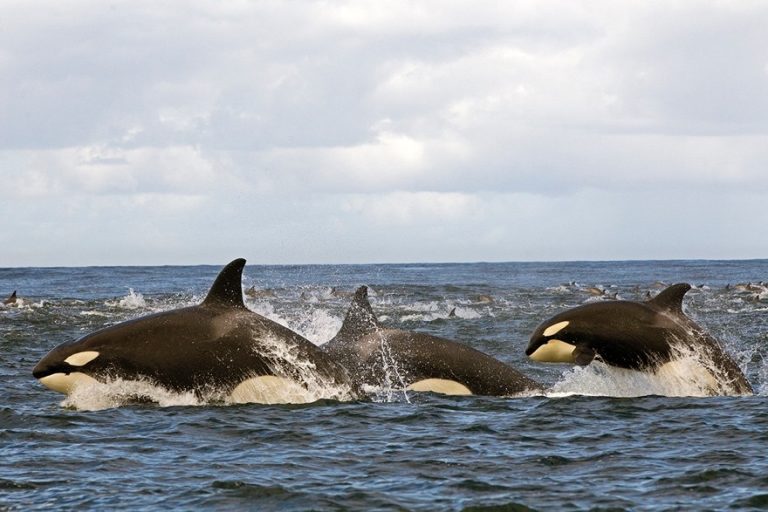
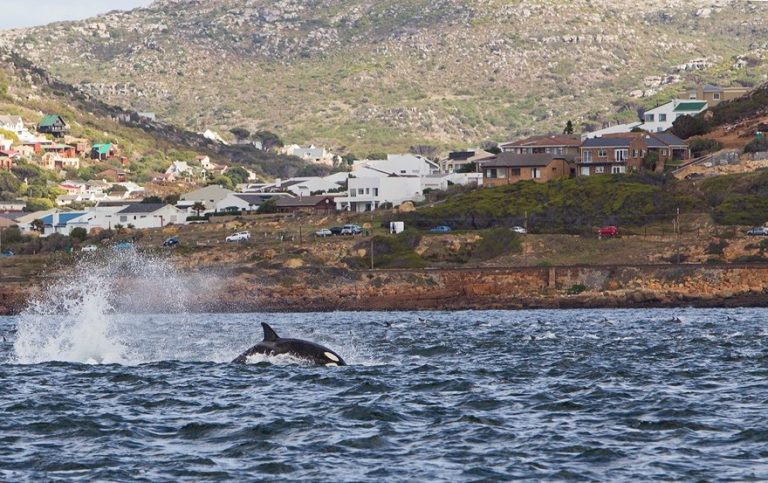
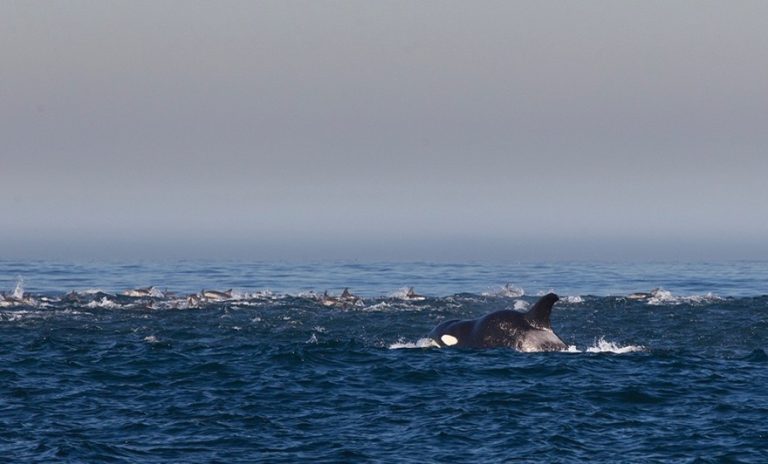
Between 2009 and 2012 Monique and I were privileged to observe Mannemerak and her family of four hunting huge schools of common dolphins, sometimes in excess of 1000 animals, on over 20 occasions.
We also saw another three different groups of orcas, in addition to Mannemerak’s family, hunting dolphins in False Bay and it was always a mind-blowing experience.
What made it even more incredible was that Mannemerak’s family often passed close to Seal Island where we were watching great white sharks knocking Cape fur seals 10 foot in the air.
While we were watching the world-famous sharks hunting the seals, we would see a wall of white in the distance as many hundreds of dolphins would create a line of spray and white water whilst trying to outrun the orcas.
No sooner had we watched the great whites hunting the seals than we would be off after the orcas hunting the dolphins.
Quite simply there was no place in the world like it.
When we followed these incredible orca hunts the strategy of the orcas was quite simple.
If we saw a hunt from the beginning, we would first see the orcas following the unaware dolphins gaining and getting closer all the time.
Then, when a couple hundred meters away from the dolphins, the orcas would dive and suddenly come hurtling through the throng of the dolphins if they hadn’t been detected by this point.
In some cases, they immediately caught a dolphin. In other cases, the miss would result in pandemonium as the school of dolphins would take off at high speed.
We would then follow at a respectable distance as the pursuit would unfold in front of us. Eventually a weak, old, sick or young dolphin would no longer be able to keep up the relentless pace and would be caught by the orcas.
Interestingly, it was virtually always the same orca in the family of four who would do the catching and killing.
This orca was a large female we named “Cleopatra”.
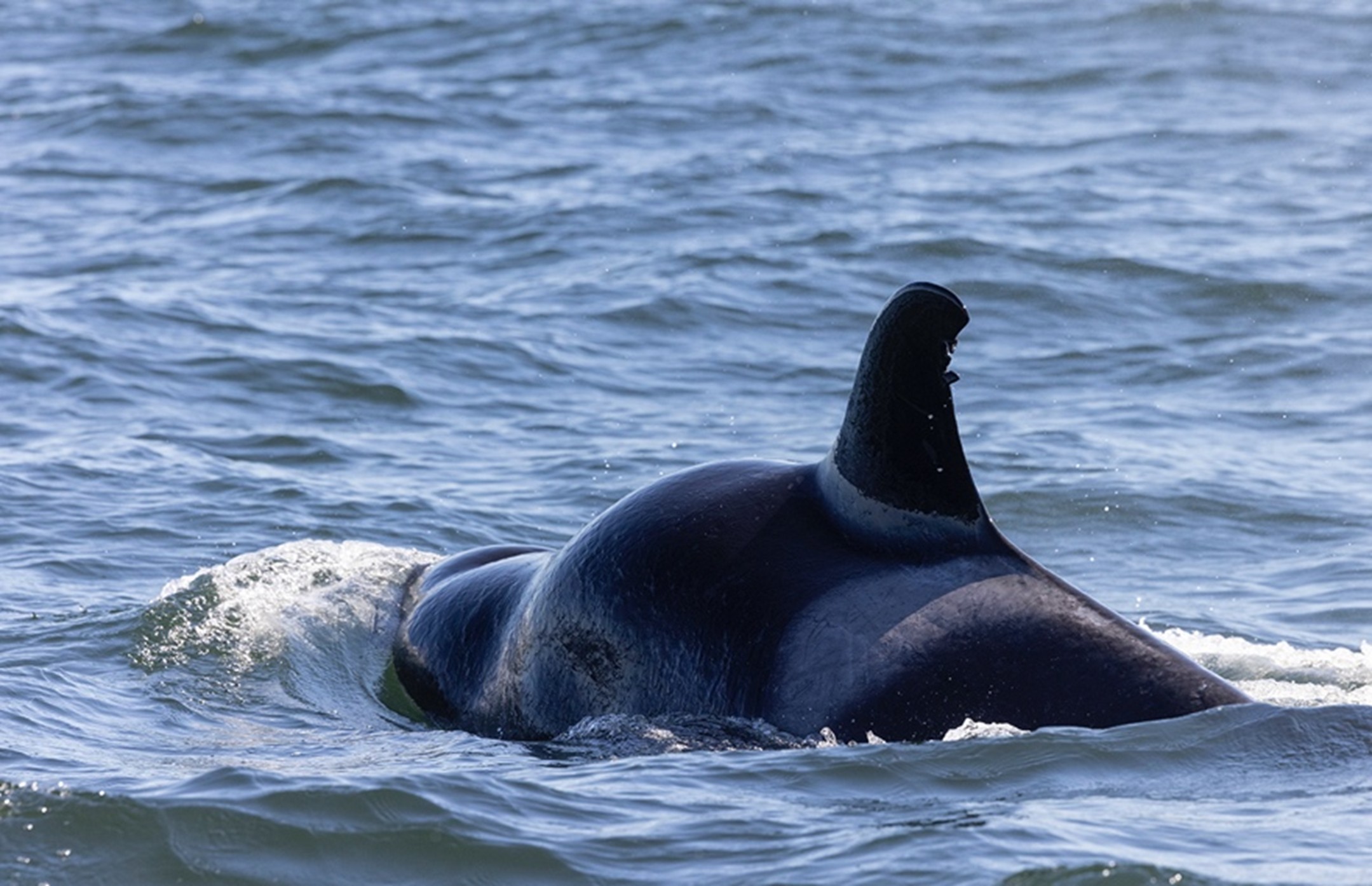
She was noticeable by her very rounded and uncommonly narrow dorsal fin that had a tiny chink out of the top. These characteristics made her easy for us to identify.
Whilst the other three orcas in her family were very interactive with us, Cleopatra was more aloof only paying us the occasional visit. She seemed far more interested in the art of hunting, which she clearly excelled.
Over the four years when we had consistent sightings of this group of dolphin-specialists, we knew it was always going to be something incredible to behold when we stumbled across them.
Sadly in 2012, a visiting foreign group of researchers knowingly drove their high-speed rubber inflatable boat right over the family, literally putting the boat on top of them, and possibly striking one or more. The group dived deep below and we never saw them in False Bay again. Coincidence? Who knows …
So, you can well imagine our excitement and happiness when in January 2025 we heard news that a group up the South African west coast called, SeaSearch, had seen an orca we instantly recognized as Mannemerak, now 13 years since our last sighting.
This interaction had been in the open ocean, 150km from False Bay where we last saw her, and up the Cape West coast in an environment very different to False Bay. Amazingly she was still alive, despite her deformity, and what was more, she was seen as part of a far larger group comprising of at least one full grown adult male, with another impressive sub-adult male also in the mix.
Although we hadn’t had the pleasure of seeing our strange looking friend again, it was good enough just to know she was well.
On the 2nd of March this year Monique and I were part of an environmental news piece about two very different outcomes for two famous marine species for a well-known South African actuality show called Carte Blanche.
One of the segments we were shooting was about the loss of South Africa’s famous great whites due to bad management and the impacts we as humans have had on these sharks.
This impact has been in large part through archaic shark nets and unsustainable fisheries, like the demersal shark longline fishery. Instead of managing or removing these impacts with sustainable alternatives that do exist, two orcas have been conveniently blamed for the great whites’ deaths, absolving those responsible from protecting them.
The reality is that the two orcas, whose actions are out of our control, have had but a fraction of the impact of what we as humans have had.
This is clearly illustrated by way of a pie chart of annual white shark mortality for the past 10 years so.
Before that orcas had no known mortality on white sharks in South Africa, and the Kwa Zulu Natal Sharks Board and Demersal Shark Longline numbers were actually even higher exacerbating the problem even further.
Giving a very different outlook, the second segment we were filming was looking at the incredible resurgence of the humpback whale population off our coast, and highlights what can be achieved when government as well as non-government scientists and the public work together, collaborating for the better of wildife.
The show essentially offers the two very different routes we can follow in terms of how we manage our oceans.
For the whale insert, we headed out of the coastal village of Yzerfontein, which lies about 80km to the north of Cape Town. We headed out with a very well-run boat based whale operation called Whale Expedition SA, run by Ashleigh Appleby.
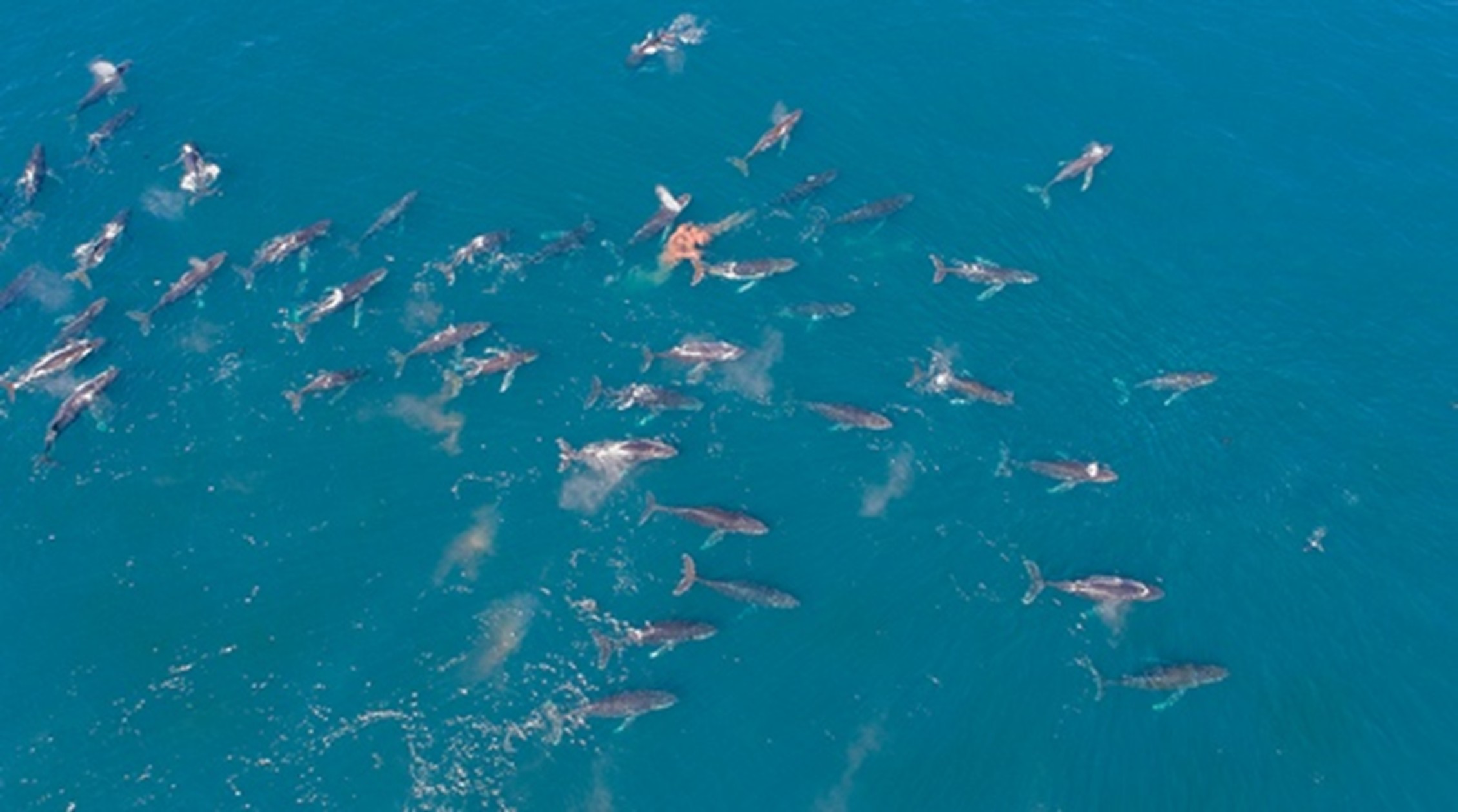
Our aim was to try and find one of the super groups of humpbacks, numbering up to 150 individuals that he had seen a week earlier.
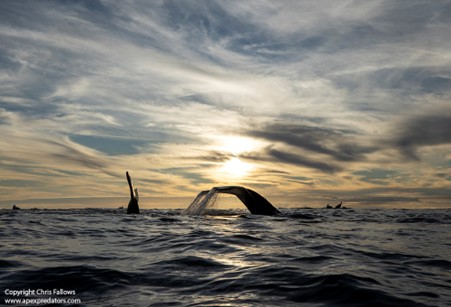
After a fruitless hour of travel, we were heading back inshore to a small island called Dassen Island. It was at this point I was dejectedly thinking how we were going to salvage the show when in the distance Ashleigh saw a series of spouts we presumed to be a group of maybe 10-15 humpbacks.
When we were about 1km away, we both instantly had a double take as we saw a large upright fin on one of the supposed humpbacks, which it turned out were orcas.
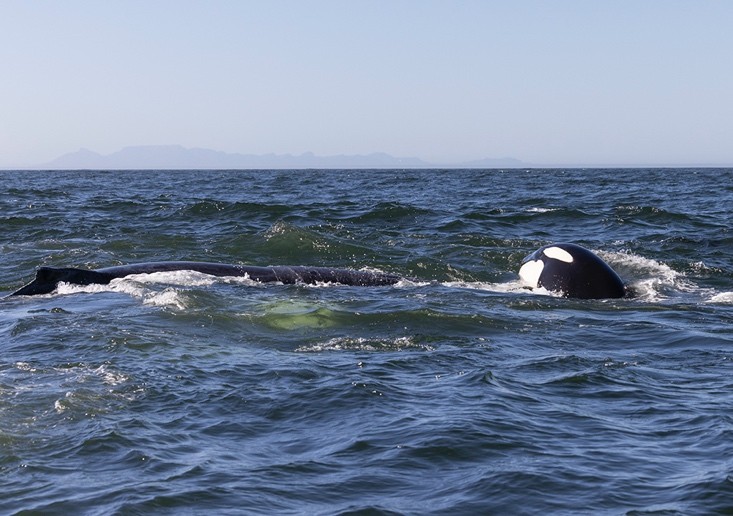
As we got closer, we saw that there were around 10 orcas severely harassing a 9-10m long teenage humpback whale.
We approached closer and it was obvious the whale, which was a whale known to Ashleigh’s team, ourselves and those who work with Alex Vogel and his HappyWhale (link – https://happywhale.com/ ) fluke ID program, was in big trouble.
After a few minutes we understood what was happening.
Three adult female orca were taking turns slamming the whale and riding on its head, trying to drown it. One female in particular was especially skillful, and determined, doing the lion’s share of the work.
As one, Monique and I recognized this stand out huntress.
It was “Cleopatra”.
The elite dolphin killer of all those years ago in False Bay had upped her game, moved north up the South African coast, and graduated to taking on the biggest prey possible … whales.
What was equally incredible was that after 20 minutes or so of barrage, the adult females backed off and a young calf took up the hunt, repeatedly trying to push the whales head underwater, trying to drown it.
The young orca was relentless as time after time it pushed and rode on the whale’s head, but due to the young orcas lack of weight and power, the whale regained some of its strength.
What we have noticed seeing these young orcas essentially being thrown into battle in various situations by their parents, is that they love the hunt. They come across being extremely excited and they are fearless.
This young orca’s assault on the whale went on for probably another fifteen minutes before Cleopatra and another female once again took up the hunt, with the calf still participating.
Of interest, the two big males, one full grown and another large sub-adult, just hung around the edges a few hundred meters away letting proceedings unfold at their leisure.
With our life spent with super predators on both land and sea, we have seen our fair share of titanic struggles and death.
It is not something we have ever become desensitized to, if anything the opposite. We have a huge respect for both predator and prey and so seeing these battles at the very top of the food chain is never easy. In terrestrial terms it was like watching a pride of lions taking down a teenage elephant, and there is no way to do that quickly or mercifully.
What was extremely noteworthy was how it was “Cleopatra” who led the charge, just like the old days when she would be the main protagonist in the dolphin hunts.
Also of interest, was just like when Cleopatra used to hunt dolphins in False Bay, she would completely ignore numerous seals she could easily have caught.
In fact, the seals followed the orcas and whale throughout this hunt often right next to the orcas, similar to what we used to see in False Bay when the orcas fed on the dolphins. The seals were almost like gawkers at the scene of a car crash, not at all afraid of the gangsters who had caused the crash and could so easily turn the tables on them.
Cleopatra was clearly a highly selective and supreme huntress, and now with an even bigger and more formidable family unit behind her, she was quite simply a living, breathing force of nature.
Eventually, when the family or orcas decided the calf had had enough practice, the three big adult females teamed up and relentlessly hung on to flippers and fluke whilst the other remaining orcas essentially rode the whale underwater, and with one last dive all the orcas together with the whale, disappeared.
For a while we saw nothing and then the orcas reappeared. Two here, three there and the males in between, all of them diving and surfacing roughly within the same area, clearly feeding on the now hopefully drowned and dead whale.
Suddenly amongst these pockets of orcas was an animal with a very noticeable deformity, it was “Mannemerak.”
It was so incredible to see her and Cleopatra again after 13 years, knowing they had survived and apparently flourished. It also reinforced the value of our collecting data, both written and photographic on each and every outing, and what it reveals over a life spent in the field.
Amongst what we assumed to be deep sub-surface feeding, we saw a few blubber pieces float up onto the surface, but not the huge oil slick and blood with attendant gulls you would expect.
After maybe 15-20 minutes of this behavior, all suddenly went quiet. The orcas had dispersed, making us wonder if they hadn’t simply targeted a few choice pieces of the whale and may simply cache, it knowing its location to come back to later.
In the early years of working with great whites, we never saw humpback whales. Their numbers were just so low in the postindustrial whaling era.
But through the efforts of passionate individuals, collaborative science and responsible boat-based whale operations, the knowledge of what is happening off our coast is rapidly emerging as numbers of these whales are once again flourishing.
This encounter is also a fine example of how, with the resurgence of the humpback whale population, these incredible displays of natural predator/prey relationships at the very top of the food chain are once again taking place, just as they almost certainly historically did.
According to Ashleigh, this was the fifth time he had witnessed encounters between orcas and whales in the past year, with it not been previously recorded off our coast in recent times. It was also the first time he was sure that the orcas had been successful.
For Monique and I, it was with respect to both predator and prey, such a privilege to witness a natural event like this.
Finally, often in a world where a well-known animal disappears it means it’s dead, to see old acquaintances alive and thriving after such a long time, it was an incredibly refreshing change.