

This month the 50-year release of the epic film ‘JAWS’ will be widely celebrated.
It was a film that undoubtedly catapulted the Great White Shark to become arguably the most famous super predator on the planet.
In 1999 I worked with Peter Benchley, the author of Jaws, for a National Geographic special on the 25th Anniversary of the film. Subsequently, I also worked on a Discovery Channel documentary with Frank Mundus, the larger-than-life Martha’s Vineyard boat captain of ‘The Cricket.’ Frank was a legendary great white shark fishermen who many feel JAWS was styled around.
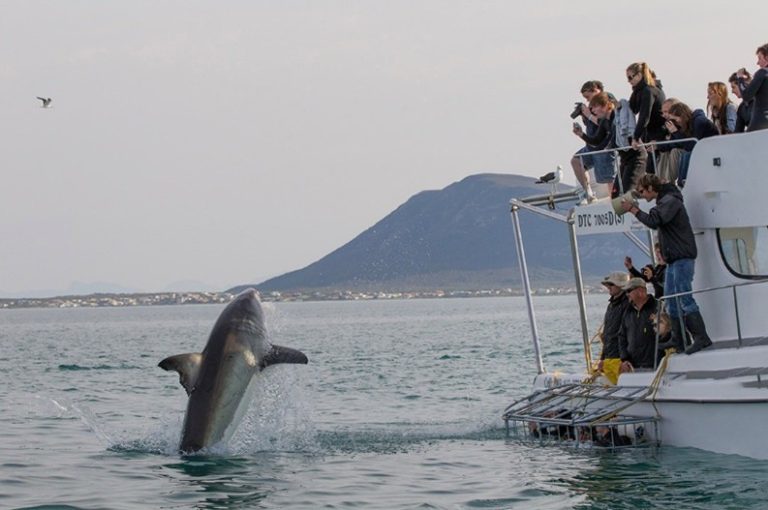
Both were drawn to South Africa’s Seal Island to see for themselves, Air Jaws, the famous real great whites I spent 25 years getting to know, and both of them were transformed by the incredible behaviour they witnessed there with me.
In this blog I will reflect on my time with both Benchley and Mundus, what Jaws led us to believe about these sharks, but what Air Jaws really taught me.


“Dear Great Whites, I didn’t really mean it.”
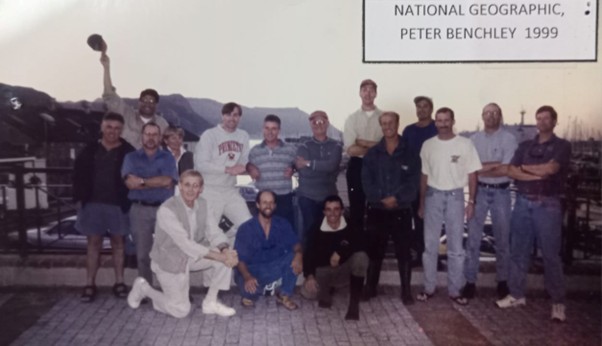
These were the words written in the New York Times in 2000 by Peter Benchley describing his feelings about the damage his book, JAWS, caused to the Great White Shark.
These words were penned in 1999 after he had spent time with me and the “real” Air Jaws at Seal Island in South Africa as well as with Rodney Fox in Australia. In both locations he got to see a very different side to the great white than the one he had portrayed.
What Benchley witnessed didn’t need sensationalism for the athleticism and beauty of Seal Island’s magnificent sharks that took to the air defied a thousand words of skilled pen stroke.
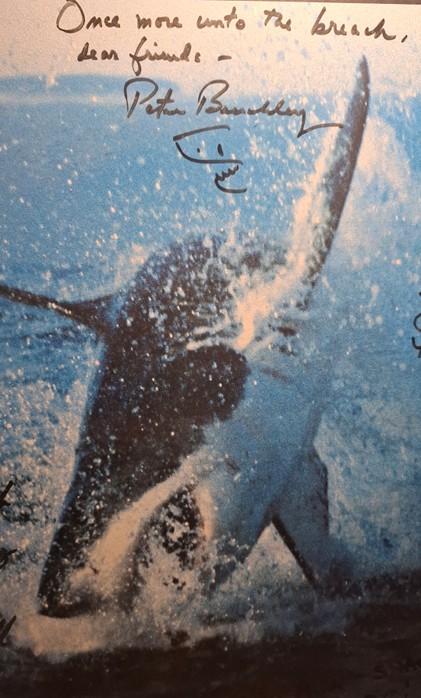
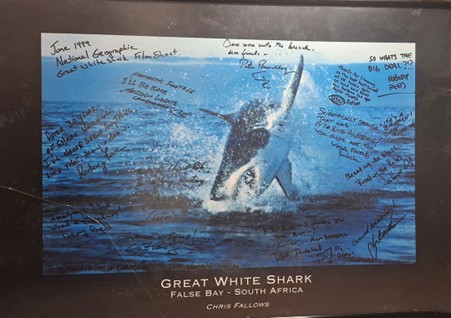
At the end of the ten-day shoot, Benchley was so enamoured with the great whites that he wanted to see fly time after time, that he signed one of my photographs with the words “Once more unto the Breach”.
It is an awakening like this that makes you wonder why we need to sensationalise or demonize an animal, that if we just do its true qualities justice, is so much more sensational than fiction could ever conjure.
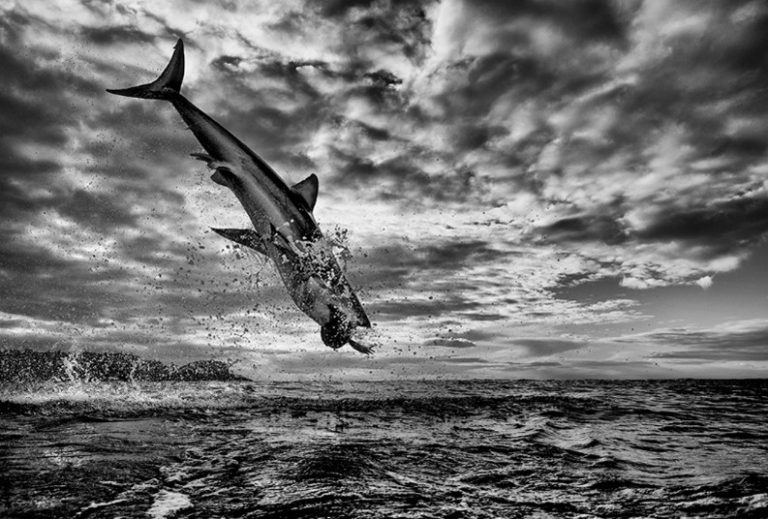
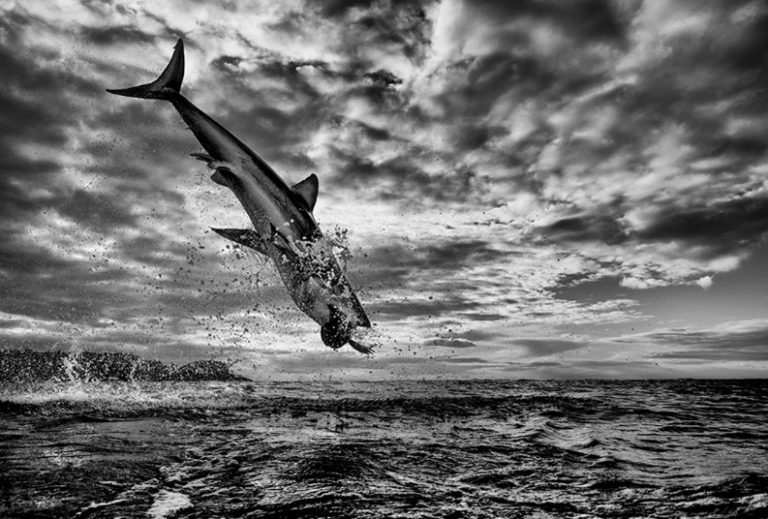
Having spent pretty much my whole adult life working with great whites above and below the water and often unprotected, I routinely get asked what I think of the film, Jaws, and the effect it had on sharks.
It is not an easy question to answer, as on the one hand, many of the thousands of guests we had join us to see the great white first became interested in the sharks because of the movie Jaws, and now they wanted to meet the monster.
They then went on to become passionate advocates for the animals’ preservation having been exposed to the real side of it.
The other side of me says, what about the hundreds of millions of others that didn’t have this opportunity to meet the real shark behind the monster, and still believe the portrayal to be true?
What about the hundreds of great whites killed by ‘game fishermen,’ who in the aftermath of the movie, were compelled to do the public a service by removing the monsters from the ocean?
Or how about the archaic shark nets that we still have off South Africa and Australia to keep beaches safe from these mindless killing machines that irrational fear precludes us from ever understanding?
Monster Man
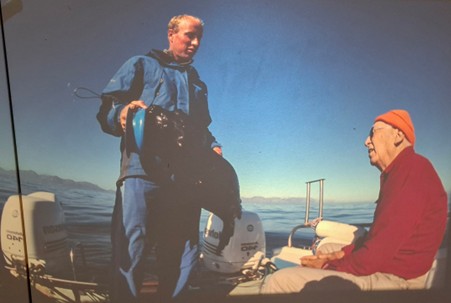
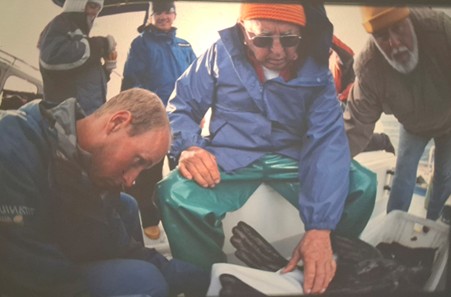
In 2005 Frank Mundus, the legendary shark fisherman who many believe that Jaws author, Peter Benchley, styled the character Quint around, joined me at Seal Island to see Air Jaws for himself.
The premise of the show was to stir the pot with the famous “Shark Hunter” meeting me, whom I guess was the “Shark Photographer and Conservationist”.

Mundus was extraordinary, a character bar none. He told of how Benchley used to ask him questions about his great white shark fishing and often joined him during shark hunts aboard Mundus’ boat, Cricket II.
He would also go into Frank’s garage and study the big Penn reels, hooks, steel traces and drums used to catch various creatures.
Mundus, quite understandably, felt that Quint was his silver screen double, a fact Benchley never admitted to in the credits of the film.
Mundus was amazed at the flying great whites and quickly his “old” ways humorously resurfaced telling me, “I will show you how to get these sharks to fly … you need ham and eggs”. Ham and eggs were his ideas of “dressing up” one of my seal shaped decoys, that I had named Frank, with trailing pieces of material to make the decoy look “injured”. Needless to say, there was much humorous banter between us.
The link to documentary is well worth a watch: https://www.youtube.com/watch?v=H4BSl3YbLO8
Going “Squint”
Whilst Peter Benchley never admitted to Quint, the central character in JAWS, being styled around Montauk’s real Life Frank Mundus, it is hard to deny Mundus’s claims.
Montauk residents have said that Mundus was definitely the inspiration for the character. John Ebel, a mate on the Cricket II said that Benchley had privately acknowledged that Mundus was the inspiration but had publicly denied the association for legal reasons. They note the following: (credit and source Wikipedia)
- Mundus and Benchley had gone on shark hunting expeditions out of Montauk prior to the 1974 novel and were filmed together aboard the Cricket II in a 1974 episode of The American Sportsman.
- In the book the fictional Jaws community of Amity Island is described as being between Bridgehampton, New York and East Hampton, New York, the latter the location of Montauk.
- Quint’s boat was said to be berthed at a place called “Promised Land.” Mundus’ boat at one time was docked at the fish factory called Promised Land in Napeague, New York immediately west of Montauk.
- Joe Gaviola, a Montauk businessman, was quoted as saying “He is Quint. If you read the book, he was everything Frank was. Benchley spent weeks fishing with him. Give me a break. He is Quint.”
- Both Frank and Quint possessed a hatred for the two-way radio.
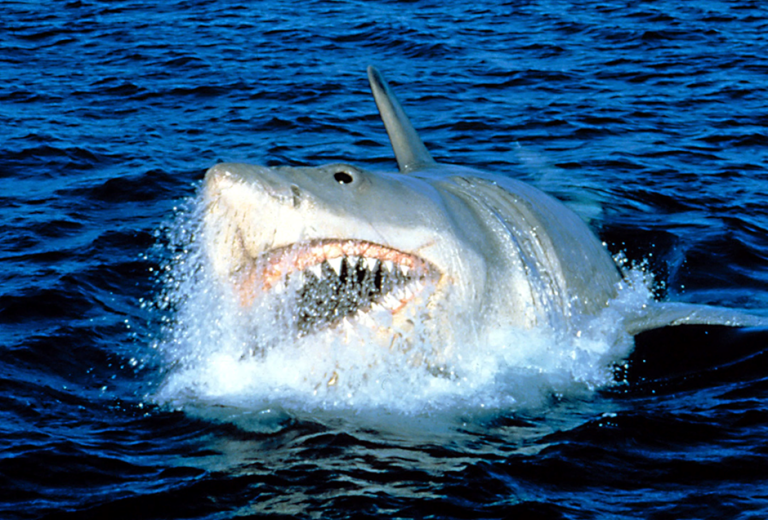
JAWS vs Air Jaws
Jaws was a mechanical Hollywood creation, 25 feet long that prowled the shores of Amity looking for its next 150-200lbs human victim. Using strange swimming strokes, oversized teeth and little by way of camouflage, JAWS swam straight to shore, dorsal fin exposed, terrifying a coastal community that seemed unable to find a safe place to swim.
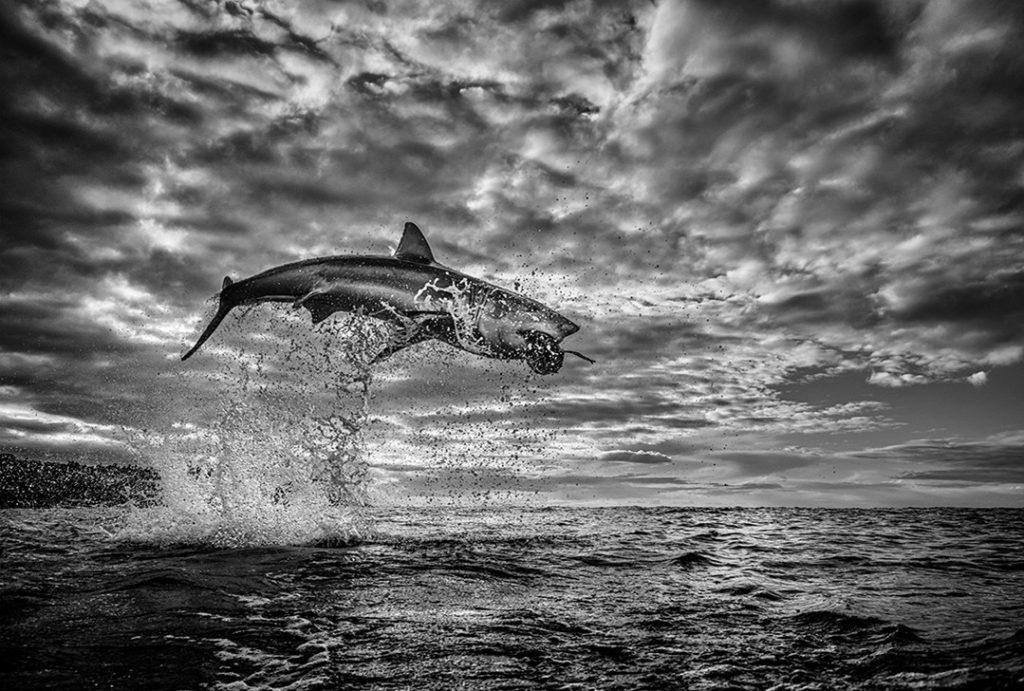
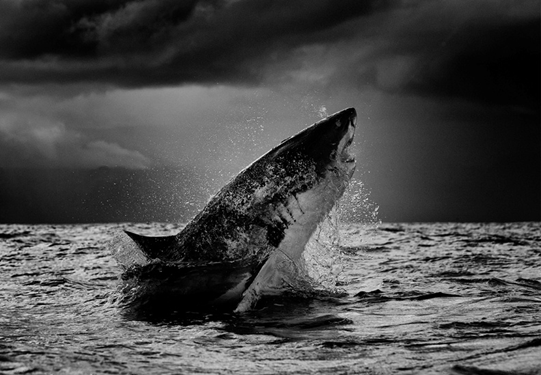
Air Jaws was a real population of sharks whose cast grew to 20ft in length and flew through the air for over a quarter of a century and was witnessed hunting cape fur seals on 10,493 occasions. These super athletic sharks used stealth, camouflage and ambush followed by high-speed vertical rushes that culminated in bursts of flight that sometimes took them 15ft clear of the water.

Air Jaws was a real population of sharks whose cast grew to 20ft in length and flew through the air for over a quarter of a century and was witnessed hunting cape fur seals on 10,493 occasions. These super athletic sharks used stealth, camouflage and ambush followed by high-speed vertical rushes that culminated in bursts of flight that sometimes took them 15ft clear of the water.
If they weren’t initially successful in capturing their prey, the seals that could weigh up to 500lbs and were equipped with sharp claws and big teeth, would use their speed and power to outwit their adversary whose counters were better agility and endurance.
And so, I ask you, was Jaws not Just A Wannabee Shark that came nowhere close to the spectacular real thing?
Jaws for thought?
That reality is that we are with great excitement going to celebrate an iconic film that was one of the greatest box office hits in history, making its creators hundreds of millions of dollars.
It is a film that shaped the way we looked at the ocean and how we perceived its foremost predatory representative.
It is a film that spawned countless documentaries over successive decades that piggy-backed off the interest in the sharks, with Shark Week and Shark Fest attracting tens of millions of viewers annually.
It is a film that, by virtue of the interest it generated around the great white, allowed me and others to run profitable and successful eco-tourism businesses that transformed coastal communities and shaped and advanced the careers of countless scientists.
In a nutshell, so many of us benefitted from the interest created by this film, but above all, we benefitted from the great white shark.
So where are all these people now in a time where the world’s once greatest population of great whites is all but gone in South Africa due to anthropogenic causes like shark nets and shark long lining?
Where are they now, where in Australia they are being wiped out in droves?
Where are they in Mexico where fishermen illegally kill hundreds of young great whites, or the Mediterranean where they are almost extinct?
We are all happy to benefit and profit from the great white, but when it needs us most, we, like the truth in JAWS, are nowhere to be seen.
