My objectives resulting from a life spent working with and trying to artistically photograph our planet’s most iconic species are twofold.
Firstly, I have endeavoured to create a unique portfolio of limited-edition photographs that artistically celebrate our planet’s most iconic wildlife.
The sale of these works allows Monique and I to achieve our personal objective which is to buy land, rehabilitate it, and add it to unbroken conservation corridors for unrestricted movement of wildlife in Southern Africa.
My second objective is to use this body of work and accompanying narrative to reach millions of people and inspire them. I do not only wish to inspire them as to the magnificence of each of the icons I work with, but additionally as to how they can be a part of the solution of how we can protect and coexist with them.
In this endeavour I look to use whatever platforms and exposure my work may have to also highlight what others are doing to try to save, restore and re wild our planet. In so doing, I hope to give any prospective person wanting to do good a bouquet of meaningful options that they can contribute towards.
Last year we achieved a major milestone regarding our second objective by partnering with the world’s busiest international airport, Dubai’s DXB and being able to reach their 90 million annual passengers through the creation of a 50m long walk through gallery.
This year we are thrilled to have another huge global platform on which to add weight to our efforts through an opportunity with CNN, the worlds most viewed news network, seen in nearly 350 million households internationally.
CNN produces four 30-minute segments each year for the Rolex sponsored series, Call to Earth, that focuses on inspiring stories pertaining to our planet.
I am honoured that one of these segments will focus on how my photography and personal lens is being used to inspire audiences as well as to draw attention to the positive choices we can make. I am also thrilled that Monique is part of telling this story alongside me.
It is also a story where, as a guest editor, I am able to highlight the efforts of others that we believe are making a remarkable difference in conserving our planet’s wildest places and species.

During our journey over the years, Monique and I have been lucky to be involved in nearly 100 documentaries about wildlife. Some of them were a struggle where everything conspired against us, others I felt I was always swimming upstream needing to steer the narrative away from sensationalism towards truth. This time however, everything colluded towards one singular cause, and that was to do good. We could simply be passionate ambassadors for nature.
We filmed four marine and two terrestrial segments that focused on our life photographing whales, dolphins, sharks and seabirds as well as conservation initiatives. Despite us only having two days to film each segment, it felt as though nature knew our intentions and was there to help. At every turn, nature brought out it’s best to make each segment a success.
At the end of the day, I truly hope that some individual in a position to make a difference will watch this show and the penny will drop, “instead of accumulating wealth far beyond my needs, why don’t I give back as helping save our planet may be the longest lasting legacy I could ever make”.
Humpback Whale Feature
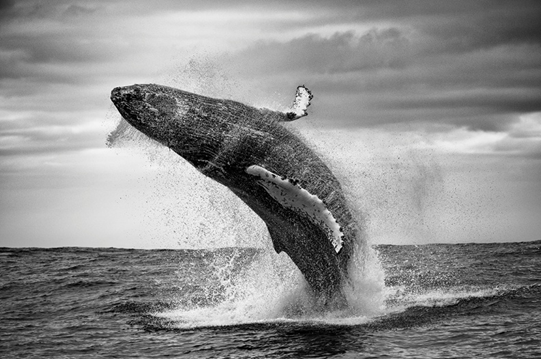
Nothing like an environmental win and great news to start off a series, and there is not much more inspiring than the resurgence of the once decimated humpback whale population.
For most people who have never experienced what it is like to be sounded by upwards of a hundred huge, forty-ton whales, I can assure you that there is probably no more sensorial wildlife experience on the planet.
You see them, hear them, smell them and even feel their breath on your skin. Combined it is a simply an all-engaging experience that leaves you feeling deeply moved.
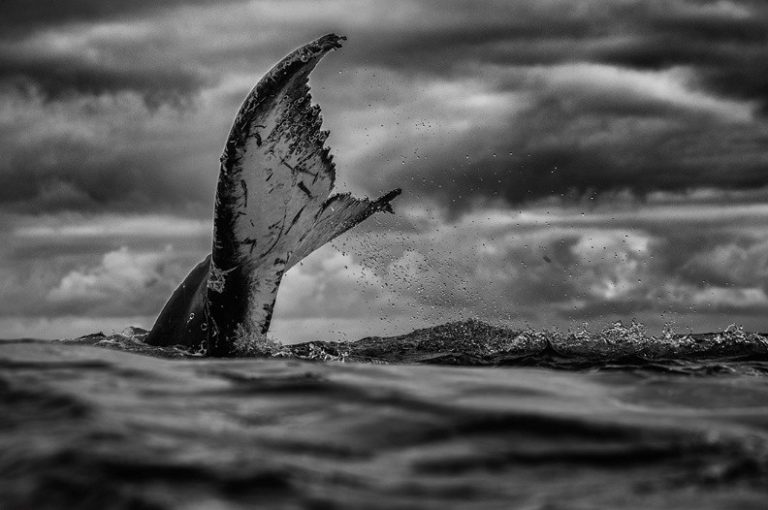
Photographically, the opportunity to create art is extraordinary with a plethora of opportunity afforded to capture evocative and moody imagery of the ultimate ‘symbol of the sea’, which for me is the whale’s huge foil like tail hoisted above the ocean.
For the first of our CNN segments Monique and I were joined by respected South African cetacean scientist, Mdu Seakamela, with whom we share our images and observational data to add to what is known about whale movement off our coastline.
We had two outrageous days on the water off the majestic Cape Peninsula resulting in data, imagery and footage that was spectacular. It was at times surreal to be the only ones at sea surrounded by over one hundred whales whilst just a few miles away over four million Capetonian’s went about their daily grind. It reminded me of how fortunate I am to have led such an incredible life but also that if we stop, look around, and are receptive to it, nature, and the art in nature is all around us, even just off the shores of a city of this magnitude.
In this segment we showed how citizen science can through the power of photography contribute to a greater understanding of the whales’ movements, the threats they face and how we can then mitigate against these threats to better co-exist.
On a creative level in this segment I share my artistic process and thinking as to how I go about conceptualising a photographic artwork using the ultimate symbol of the sea, a whales tail.
At the end of the day through my artwork I want to take my audience to the ocean, allow them to unwind, and vicariously connect with the oceans most sentient creature. In essence I aim to marry art with emotion.
I like to believe that the fruits of these two days with CNN resulted in a few eye catching works for anyone wanting art that reflects their love of the ocean.
From Super Groups to Mega Pods
If ever there was an animal that brings a smile to both young and old, it is a dolphin.
That smile gets magnified many times more when that single dolphin is part of a mega pod of a thousand or more.
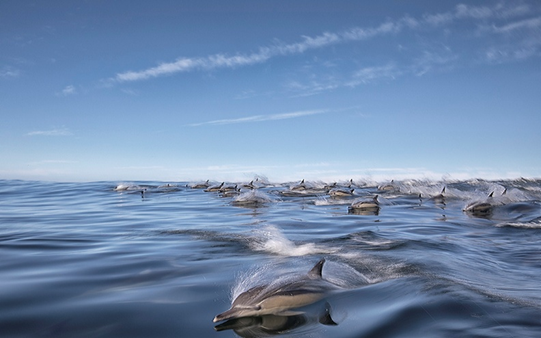
I know for most such a sight seems impossible, so if you have never had the privilege of experiencing this natural phenomenon, then close your eyes. Imagine a thousand bodies with an hourglass pattern stamped onto their sides racing through water, imagine the sound of this water is akin to a river flowing fast over stones, and then from within the midst of this frenetic activity, picture seeing hundreds and hundreds of columns of steam rising against an orange sunrise as dolphins exhale between dives.
Imagine this, or you can watch as we come across not a school of a thousand dolphins, but probably well in excess of two and a half thousand. This incredible scene was our unbelievable canvas as we filmed and photographed the mega pod plough across the golden mercury-like waters of False Bay as the sunrise ushered in another beautiful morning.
Photographically my objective here was to tell the story of abundance, to bring the mega pod into someone’s home by way of a photograph that transports them into the throng of a thousand or more animals. In so doing I employed techniques like motion blur to add an artistic twist, but also to freeze the moment in a way that emphasises the incredible energy that is within these huge schools of animals.
You would think at times like this it is easy to take a great shot but see how challenging it is when I try to isolate individuals from within the melee or even do justice to the scale and scope of the spectacle itself.
Mako Sharks in The Deep

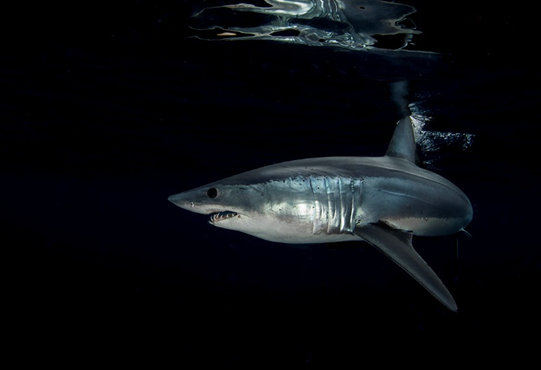
Is it a Ferrari, Mercedes or McClaren? No, it’s a mako shark, the most beautifully designed predator in the ocean.
The loss of the famous great white sharks of South Africa due to anthropogenic (human related) causes has been an incredibly painful pill for Monique and I to swallow. We spent nearly thirty years of our lives with these incredible animals getting to know them intimately like few ever have.
Today I use this painful journey to tell one part of a story about what can happen when we let ignorance, apathy and politics get in the way of addressing a species’ need for help.
When the great whites were lost, Monique and I headed far offshore in search of the great white’s closest relative, the mako shark.
In this segment, I show how if we address our deepest fears relating to predators we have little to fear and even under conditions where all cards are stacked in their favour, they still choose to tolerate rather than threaten me.
Photographically I believe the mako shark is possibly the most beautiful predator in the ocean, and there is no way better than to show this iridescent beauty off than against a setting sun or veil of darkness. My artistic objective is to hero the form, shape and colours of the design of the mako. Hence shooting at night against a black back drop that really emphasises the colours of and sharp lines of my subject. I also shoot against the acute sun’s rays of sunrise or sunset to get the effect of stage lights illuminating the mako as it essentially performs on its stage, creating a beautiful sunburst effect underwater with bold rich colours.
Join me as I go into the mako’s world after dark and see the results of when this most magnificent of predators dances under the lights.
The Aviators
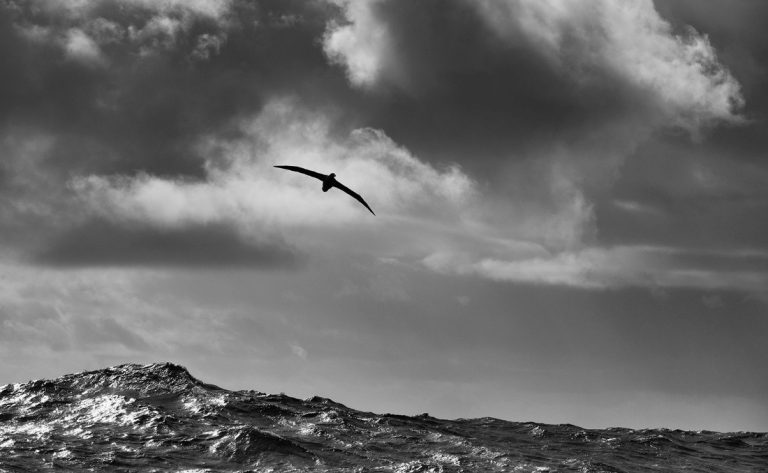
Perhaps there is no creature alive that moves as effortlessly as the albatross atop a huge swell in a deep Atlantic depression.
Yet today, 17 of the 22 species of Albatross face extinction, primarily due to entanglement in fishing gear and loss of prey.
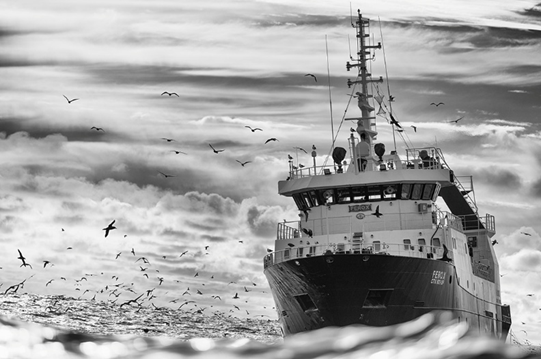
Far off the coast of Cape Town, huge South African stern trawlers ply their trade dragging nets to catch hake, a species of fish likeable to North Atlantic Cod. Following the trawlers, like the living tail of a comet, thousands of seabirds hope to scavenge upon bycatch or discards. From the trawler’s stern, tori lines or bird scarers are dragged to help prevent bird strikes against the taught steel cables which drag the nets. For the most part it works and shows that small adjustments can make difference.
The chaotic scene of all these huge birds competing alongside these steel behemoths is surreal and one that offers the few of us who venture out here incredible photographic opportunities to tell a story. With shallow depths of field and low angles I look to to take the viewer into the throng of birds, accentuate their number, and then also look to bring out the strong industrial look and feel of the huge steel ships scouring our ocean
In this segment I talk about how sometimes it is not just about trying to create my next marketable artwork, but rather about telling a story and giving people insight and access to a world that few will ever get to know. It is about letting a photograph stop people in their tracks and make them think. What is the ecological price of our plate of fish, how is climate change affecting the world of the elephant, who is doing what to save the last great wild places?
It is not for me to question, but rather through the unspoken word of photography to talk.
Nyerere and Ruaha National Park – The Lungs of Africa
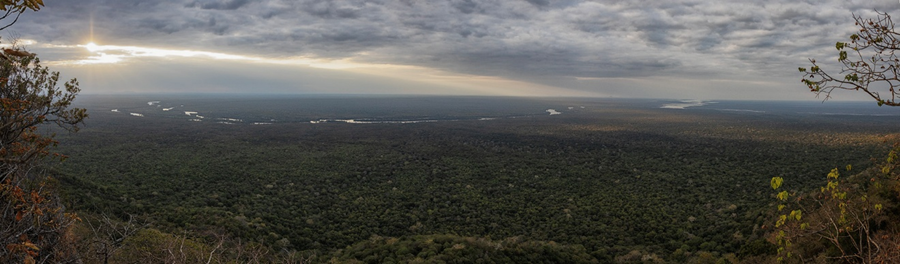
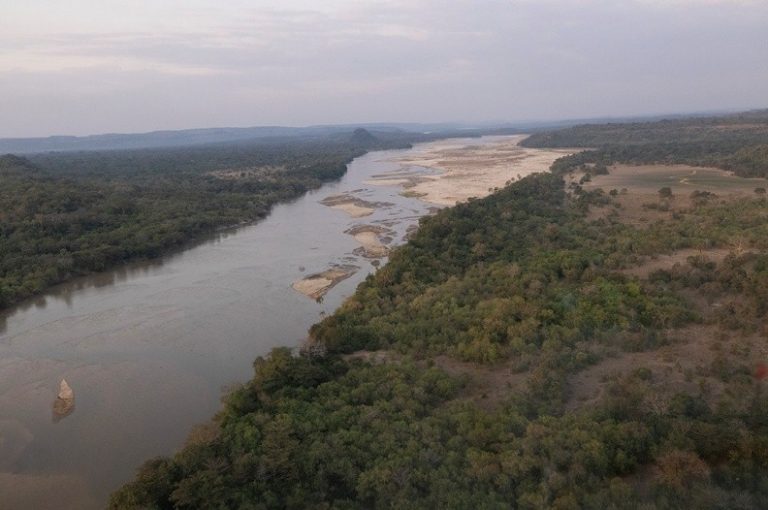
In our endeavour to highlight the efforts of others, we travelled to Southern Tanzania for the next segment to spend time with the NGO, Six Rivers Africa (SRA), to hear more about the partnership with SRA and the Tanzanian Government in Nyerere and Ruaha National Parks.
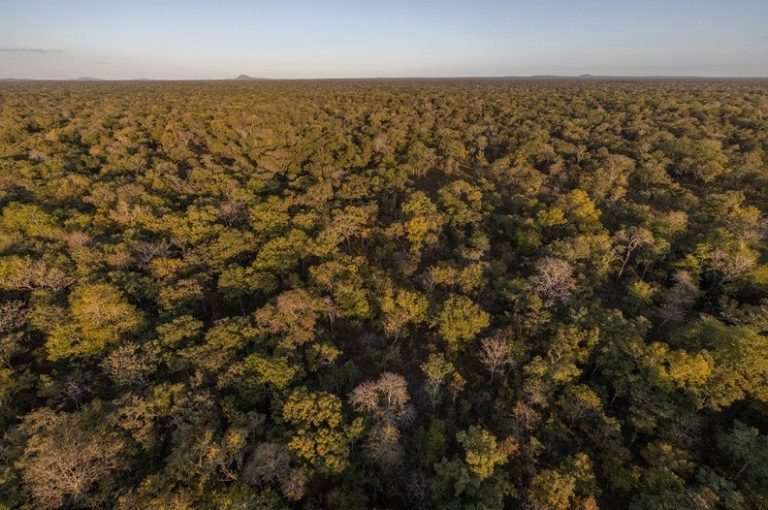
The experience left me feeling energized and full of hope for our planet. We saw places so wild that for two and a half hours, flying nonstop in a helicopter at over 200kmph, all we covered was virgin forest. I stood atop sheer 1500m mountain peaks where I doubt a human footfall has been before, and in my footprint were buffalo droppings flanked by rare protea plants, whilst in the distance we saw a herd of elephants walking a narrow path atop a steep ridge line at over 1000m. From gorges to grassland, and waterfalls to swamps, as far as I could gaze, all we saw was true wilderness.
As much as I am wildlife centric, perhaps what gives me the most hope is the attitude towards conservation from the various people within the Tanzanian Government and SRA who are working together to conserve this vast wilderness that is twice the size of Switzerland.
Tarangire National Park, Tanzania
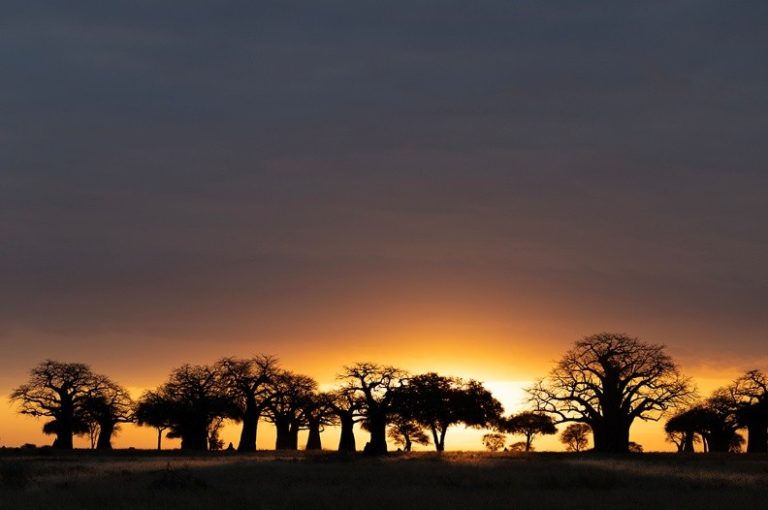
As a final segment to the show, we headed to Tarangire National Park for a few days where Nomad Safaris played host to our visit at their beautifully situated Kuro Camp. My objective at Tarangire was to show that if efforts in Nyerere and Usangu in Ruaha National Parks continued, tourists would soon be able to get up close to see Africa’s great icons, just as you can now do in an established park where nature had learnt to trust humanity.
With time, be it fauna like elephants or flora like baobabs, the photographic results of the rebirth of these great Edens and getting close to its inhabitants will speak for themselves.
Whilst I generally spend weeks, months and often years trying to conceptualize and ultimately take a truly exceptional fine art photograph that I feel comfortable including in my limited edition portfolio (link), here we had just three days.
As with the other Call to Earth shoots before this, luck was to be on our side. Together with the skilled Nomad guides, we headed out each morning to where the huge stands of baobabs cut their 800–1000-year-old silhouettes against the orange African skyline. It is here that I hoped to marry the giants … elephants and baobabs.
Whilst searching and waiting for this kind of opportunity, we got a call to say a leopard had been seen in a nearby baobab tree.
This call gave promise of a scene that I, like many others, had dreamed to see and photograph.
And so, we abandoned our goal of the elephants and a baobab and headed off to find a golden gem nestled into the textured boughs of the huge ancient tree. It was simply magical and we sat with the cryptic cat for over five hours as she adjusted her position every now and again to enchant our lenses.

Needless to say, the weeks spent on this shoot have been simply amazing, but perhaps most amazing of all was experiencing the wild places we did, witnessing the abundance of wildlife on both ocean and land, and acknowledging the amazing and dedicated people trying so hard to keep this all safe.
If ever there was a real legacy to leave, and a Call to Earth for those with the means to do good, it would be to support the efforts of those highlighted in this feature who protect these wildest of remaining places and the ecosystems they support.