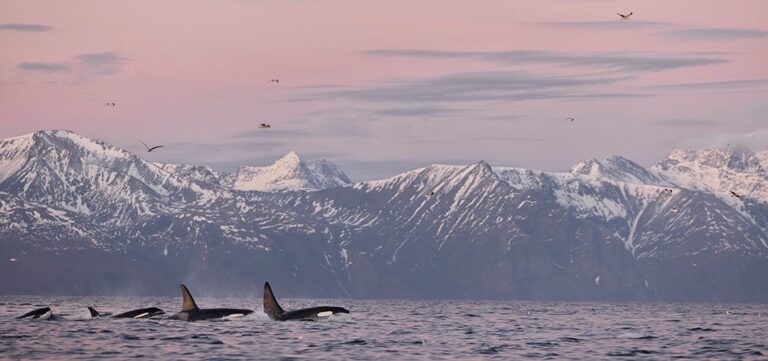
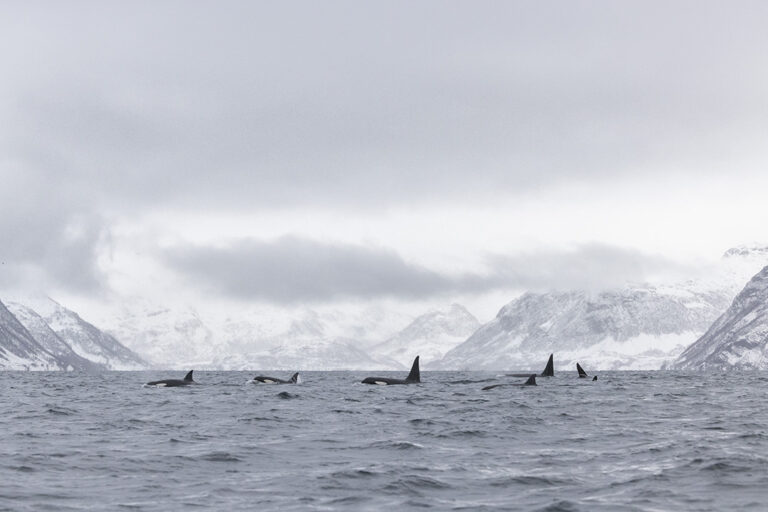
Orcas are arguably the smartest, most specialised and widely distributed super predator in the oceans of the world.
Having seen orcas in most oceans, Monique and I had wanted to experience and photograph the herring-hunting orcas in Norway for many years, but for one reason or another we just never got there. This October the stars aligned, and we were on our way to Norway …
The wait was most certainly worthwhile. On many days we encountered over a hundred different orca (yes,100!) as they patrolled the fjords looking for herring and herring fishing boats. The scenery was breathtaking, and seeing dozens of Humpback whales, as well as coming across several Fin whales that we got very close views of, were fantastic bonuses.
Whilst I had planned to dive with the orcas, I decided that, rather than join the melee of tourists in the water, who I have to say from the few times we saw multiple divers on orca bait balls were all very respectful and well behaved, to rather focus on quieter fjords where we found many pods to ourselves in often extreme weather with gales, snow, hail and ice all being part of the mix.
The massive herring purse seiners, that take out hundreds of tonnes of fish in a single catch, were magnets for the orcas, humpbacks and thousands of herring gulls. Herein lies an ecological dilemma that I was previously unaware of.
The orcas, rather than hunting and balling shoals of herring, are ever more resorting to scavenging off the fishing boats, as were the humpback whales.
Inevitably, engagement with the fishing fleet means entanglement. This not only happens in the seine nets, but also in the many hundreds of gill nets set each day in the fjords. The orcas do not have the strength to break free and tragically, they drown.
For the most part, the humpbacks are said to break free, although when we were on site a humpback had just drowned, with another 12 whale entanglements as well as an orca death reported during our ten days spent in the area.
Probably the most overlooked victims however are the herring gulls. In the excitement at the nets being hauled, the birds actually drown each other in their efforts to get to the fish. The herring fishery and some scientists say there is no problem, but in our limited time we saw many dead birds, sometimes double digits, after each netting event. If this number gets multiplied by how many vessels are fishing, and how often they are setting their nets, then it is several thousand birds over a season which very clearly is a problem.
The seine netters are supposed to fish outside the fjords as they are easily able to handle the open ocean conditions, but rather choose to fish inside them due to calmer seas. Fishing inside the fjords is a problem, as not only are they likely changing the natural order of things by way of creating easy feeding conditions for orcas, rather than the orcas balling fish, but as the vessels are now so accessible to the birds, many more are dying.
As is so often the case, it was very hard to appreciate the beauty of a spectacle like dozens of orcas when you witness the dead fish, birds and bycatch dumped after each netting event.
Although I hate to harp on the negative, it would be shallow and disingenuous of me not to mention it and raise the question that there has to be a better way to allow both fishermen and nature to carry out their respective lives connected to the herring.
In closing, we would like to say a huge thank you to our good friend Eirik Grønningsæter who helped to plan this trip with us. It was fantastic to share this experience with Eirik, and we really appreciated his expertise and experience in this spectacular part of Norway.